
India's services PMI recovered from its ten-month low in September to reach 58.5 in October supported by strong expansions in output and new business, which in turn boosted job creation, a monthly survey said on Wednesday. The seasonally adjusted HSBC India Services Business Activity Index increased from 57.7 in September to 58.5 in October, as robust sales pipelines and strong demand conditions supported the upturn in business activity. In the Purchasing Managers' Index (PMI) parlance, a print above 50 means expansion, while a score below 50 denotes contraction.

Since January 2021, the inflation rate in health has stood in the range of 6.08-8.44 per cent.

'Both IIP and CPI inflation numbers are showing a huge disconnect from the leading indicators.'

Quarterly earnings of corporates, trading activity of foreign investors and inflation data are the key factors that are expected to drive the momentum in the equity markets this week, analysts said.

Fada estimates that global supply chain headwinds like scarce availability of rare earth elements for electric vehicle components and geopolitical tensions may affect urban consumer sentiment in June as well.

Marico reported consolidated revenue growth of 20 per cent year-on-year (Y-o-Y) during the January-March quarter (Q4) of FY25. Domestic revenue surged 23 per cent Y-o-Y, while volume growth was 7 per cent. International growth stood at 11 per cent (16 per cent in constant currency growth).

However, some analysts say RBI Governor Raghuram Rajan may delay the rate cuts amid mounting concerns over the government's fiscal health.

Retail inflation declined to a one-year low of 5.72 per cent in December 2022, mainly due to softening prices of food items, according to official data released on Thursday. The Consumer Price Index (CPI) based retail inflation was at 5.88 per cent in November 2022 and 5.66 per cent in December 2021.

'The government's priority is not farmers.'

Retail inflation hit an eight-month high of 6.07 per cent in February, remaining above the RBI's comfort level for the second month in a row, while wholesale price-based inflation soared to 13.11 per cent on account of hardening of crude oil and non-food item prices, government data showed on Monday. The previous high for retail inflation was 6.26 per cent in June 2021. The consumer price index (CPI) based retail inflation, which is taken into account by the Reserve Bank of India (RBI) while deciding its monetary policy, rose mainly because of costlier food items, as per the data released by the National Statistical Office (NSO).

Retail inflation fell to a 15-month low of 5.66 per cent in March, mainly due to a decline in food prices, government data showed on Wednesday. The inflation figure in March is within the RBI's comfort zone as it is below 6 per cent. The retail inflation based on Consumer Price Index (CPI) was 6.44 per cent in February 2023 and 6.95 per cent in the year-ago period.

Maintaining 4 per cent inflation is appropriate for India as targeting a lower rate could impart deflationary bias to the monetary policy, said a Reserve Bank paper. Under the current dispensation, the RBI has been mandated by the government to maintain retail inflation at 4 per cent with a margin of 2 per cent on either side. The paper, authored by RBI Deputy Governor Michael Debabrata Patra and another official Harendra Kumar Behera, has found a steady decline in trend inflation to 4.1-4.3 per cent since 2014.

Retail inflation declined to an 18-month low of 4.7 per cent in April mainly due to falling prices of vegetables, oils and fats, and came closer to Reserve Bank's target of 4 per cent, showed government data released Friday. It was for the second month in a row that Consumer Price Index (CPI) based inflation remained within the RBI's comfort zone of below 6 per cent. The government has tasked the central bank to ensure retail inflation remains at 4 per cent with a margin of 2 per cent on either side.

Reserve Bank of India (RBI) is unlikely to cut the benchmark interest rate at its upcoming monetary policy review meeting, taking place soon after the announcement of the Lok Sabha election results, amid inflation challenges, said experts. The Monetary Policy Committee (MPC) may also refrain from rate cut as economic growth is picking up, notwithstanding the elevated interest rate of 6.5 per cent (repo) prevailing since February 2023. The meeting of the Reserve Bank Governor Shaktikanta Das headed MPC is scheduled for June 5 to 7.

The Consumer Price Index-based inflation rose to 5.11% in January

To those who ask, "Is all this really worth it? Why can't domestic demand fill the gap?", it is important to remind them that only 13 economies since the Second World War have grown at 7 per cent or more for 25 years -- like India needs to. They all had one thing in common: Strong export growth underpinned by strong global engagement, explains Sajjid Z Chinoy.

Driven by rising prices of food items such as sugar, pulses and vegetables as well as clothing, retail inflation moved closer to the double digit mark.
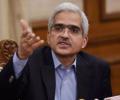
The Reserve Bank of India Governor Shaktikanta Das on Monday said that the "momentum of inflation is on a downward slope" and the central bank would continue to strike a delicate balance between the need to contain price rise and ensure economic growth. The Reserve Bank's inflation projections, Das said, are "robust" but contingent on downside and upside risks associated with the movement of global crude oil prices. The RBI takes into account a particular range within which crude prices are expected to fluctuate considering all the factors that can be anticipated and that can be sort of foreseen as of today, he said.
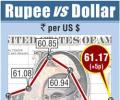
Data late on Wednesday showed consumer price inflation eased more than-expected to a 25-month low of 8.10 per cent in February, while industrial output unexpectedly expanded, albeit only by 0.1 per cent.

Analysts expect inflation to peak in the first half of 2016-17 and moderate, thereafter, on the back of positive impact of monsoons

Industrial production was seen growing 1.8 per cent from a year earlier in July, slower than June's 3.4 per cent increase, according to the median consensus in a poll of 31 economists.

Consumer-focused companies have been left with few options but to increase the prices of their products as input costs mount because of various factors, including supply chain disruptions. This has been affecting monthly household budgets. Prices of scores of items -- from spices to soaps to rice -- have increased in the past year.

It is for the second consecutive month that the retail inflation has been above the RBI's comfort level.

Government, RBI sign pact to target CPI at 4%.

The country saw two straight years of deficient monsoons.
Hit by inflation, higher input costs and pricing measures, fast-moving consumer goods companies are expected to see a contraction in their gross margin and a modest-to-flat operating profit in the October-December quarter. Several FMCG makers are likely to log a low single-digit rise in their revenue, returning to the cycle of value-driven growth.

Inflation pegs down currency value, re-allocates resources, reduces potential economic growth and leads to the attrition of gross domestic savings.

Stock markets will be driven by domestic inflation data, ongoing quarterly earnings from corporates and global trends this week, analysts said. News flows around the general election would also be tracked by investors, market experts said.
The wholesale price-based inflation rose to a four-month high of 14.55 per cent in March, mainly due to hardening of crude oil and commodity prices, even though vegetables witnessed easing of price pressures. As per the government data released on Monday, WPI inflation has remained in double digits for the 12th consecutive month beginning April 2021. The last time such a level of WPI was recorded was in November 2021, when inflation was 14.87 per cent.

Elevated food price-led inflation could become a sore point for markets, which they seem to be ignoring at current levels, observe analysts. Retail inflation in India - as measured by the Consumer Price Index (CPI) - came in at a three-month high of 6.52 per cent in January 2023, compared with 5.72 per cent in December and 5.88 per cent in November 2022. The inflation print for February, according to Madan Sabnavis, chief economist at Bank of Baroda, will be critical for the Reserve Bank of India's monetary policy committee.

The wholesale price-based inflation spiked to 12.54 per cent in October, mainly due to rise in prices of manufactured products and crude petroleum. WPI inflation has remained in double digit for the seventh consecutive month beginning April. Inflation in September this year was at 10.66 per cent, while in October 2020 it was at 1.31 per cent.

Almost 50% respondents said Modi has not done enough to check prices of essential commodities.

'Growth, liquidity and deposit mobilisation are likely to be discussed during the interaction.'

There's an average aggregator premium of Rs 46 per dish (in hidden costs) compared to delivery orders placed on restaurants' own channels. Conservatively, this translates into an additional annual financial burden of at least Rs 12,000 for the average Indian household in major metro/Tier-I cities.
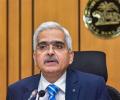
The Reserve Bank of India on Thursday decided to keep policy rate unchanged for the sixth time in a row as it maintains a tight vigil on inflation. The rate increase cycle was paused in April last year after six consecutive rate hikes aggregating to 250 basis points since May 2022.

Bajaj Auto - the country's most valuable two-wheeler (2W) company by market capitalisation - met Street expectations in the January-March quarter (Q4) of 2024-25 (FY25) but still ended Friday as the worst performer on the Nifty 50, slipping 3.1 per cent.

Despite gross domestic product (GDP) growth being lower-than-expected for the July-September quarter, the six-member Monetary Policy Committee (MPC) may not cut the policy repo rate in the review meeting scheduled for next week due to high inflation in October, according to experts. "Consumer Price Index (CPI) inflation breaching the upper limit of the RBI's tolerance band in October (6.2 per cent year-on-year) is not a favourable backdrop for the MPC to commence the easing cycle, even as the growth outcome disappointed the MPC's expectations," said Shreya Sodhani, regional economist at Barclays, who expects the policy repo rate to be kept unchanged in the December meeting.

As per commerce and industry ministry data, food inflation fell to 4.91 per cent in March from 7.79 per cent in the previous month.

The Indian services growth broadly steadied in May and was underpinned by healthy demand conditions, new client wins and greater staffing capacity, a monthly report said on Wednesday. The seasonally adjusted HSBC India Services PMI Business Activity Index was at 58.8 in May, marginally up from April's 58.7 and signalled another sharp rate of expansion.

Factory output in June likely rose 5.4 per cent from a year earlier, faster than the 4.7 per cent growth in May, according to a poll of 27 economists.
 © 2026 Rediff.com - Advertise with us - Disclaimer - Privacy Policy - Sitemap - Feedback - About us - Terms of use - Grievances